
It is likely that Sydenham Farm came into being following the Enclosure Act of 1768 when common land went into private ownership. Fields were divided by fences and hedges and farms were developed. Matthew Wise of Shrubland Hall was awarded “Sydenham Fields and Sydenham Meadowe”. The exact date that the farmhouse was built is unclear but the Sydenham Farm buildings and The Cottage, which belonged to the farm, first appear on maps dated 1887. Wharf Cottage, the lime kilns adjacent to the canal, and Rushmore Farm, situated next to the railway at Black Bridge, also existed then but were under different ownership.
The land was leased by the Wise family to Joseph Stanley and his wife, Mary, who occupied the farm from 1876 until the mid-1920s. There is evidence, however, that the farm was leased to the Stanley family prior to 1876, as reference is made to a Joseph Stanley of Sydenham Farm in the Leamington Courier of 18th May 1844, possibly the grandfather of the later Joseph.
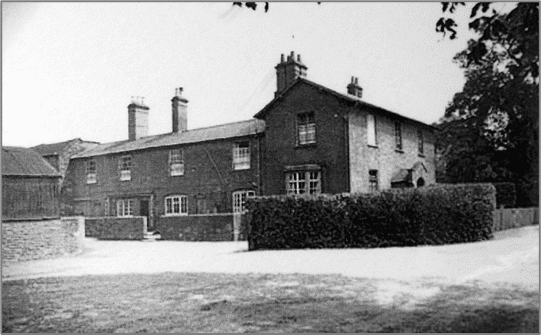
Cereal crops, potatoes and other vegetables were grown and animals were reared. During the Stanleys’ time Harry Godfrey ran the lime kilns adjacent to the canal near to Wharf Cottage. Limestone was brought in from Stockton by narrow boat, unloaded at Gulliman’s Wharf and burnt in the kilns, the lime being either spread on the land or used in the building trade. Canal bridge number 36 linking Radford Road to Wharf Cottage and the lime kilns is known as Gulliman’s Bridge. The small late-1990s development between the canal and Radford Road is called Gulliman’s Way. The lime kilns are depicted in Thomas Baker’s painting of 1859 entitled “Harvest at Radford, Warwickshire” which is now in a private collection.
From 1884 until 1914 polo was played on farmland adjacent to the farmhouse, Joseph Stanley becoming the manager of the grounds and later Club Secretary. This site was later used as an airfield for pleasure flights over Leamington and the surrounding area, led by Alan Cobham, a former First World War pilot.
In the mid-1920s Arthur Tickle and his wife, Joan, took over the farm, first as tenants then in 1954 as owners. Mr Tickle, who had become Alderman Tickle by that time, paid £12,000 for the farm, which included The Cottage and Wharf Cottage. Mr Tickle’s herdsman, Frank Beard, occupied The Cottage, attached to which was a special pen where the bull was kept for hiring out to other farms.
During the 1940s Len Shurvinton, whose mother used to work as a cleaner for Joan Tickle, made a number of sketches of the farm outbuildings and animals as part of his painting and decorating apprenticeship with the Wallsgrove Brothers. Len’s family lived in Waverley Road. Len remembers that Mr Tickle kept a few sheep and cows, and grew potatoes and wheat. At the rear of the farmhouse was a large wooden building where Joan Tickle raised chickens. Mr Tickle employed three men, Frank Beard, Ralph, who lived in Wharf Cottage and Fred Leatherman, the ploughman.
Howard Boiles, born in 1929, was the son of William and Nellie Boiles who lived at Wharf Cottage. William worked at Shrubland Farm (now the Kingsway Estate), and they lived in Wharf Cottage until 1933. In 1945, at 16 years of age, Howard started work for Arthur and Joan Tickle. He went on to be the farm’s cowman and was responsible for the herd of over 30 cows, as well as the young stock. Although the cows were his main responsibility, he was involved in any other work that might be required. Howard was to stay at the farm for ten years until 1955.
At that time Sydenham Farm had ten acres of potatoes, ten acres of sugar beet, ten acres of wheat, and barley and oats for feeding cattle. During the potato harvest the schools allowed pupils to help with the extra work. They collected potatoes in woven baskets made of strips of oak. These were used for many other purposes, including carrying feed for the horses.
In 1949 and 1950 the local authority built four ‘cottages’ on what was Stanley’s Lane. They are now numbered 1, 3, 5 and 7 Sydenham Drive. These were tied cottages for agricultural workers, the first two for Sydenham Farm and the remaining two for farmer Butlin at Newbold Comyn Farm. The houses are now privately owned.
Friday 3rd April 1959 was a significant day for Sydenham Farm. On that day, Arthur Tickle’s herd of Pedigree Dairy Shorthorns, the Radford Herd, was sold at auction, together with all his farming stock and implements. Arthur Tickle sold the land for the development of Sydenham Estate to A C Lloyd, the building company. Joan Tickle’s name lives on in Joan’s Close, off Gainsborough Drive.
Sydenham Junior School occupied the site of the farmhouse from the early 1960s until the late 1990s but this later gave way to the SYDNI Centre which was built in 2002.
This page is one of many which are based on articles in our book entitled A History of Royal Leamington Spa in 100 Buildings which was published in 2018 and is no longer in print.