
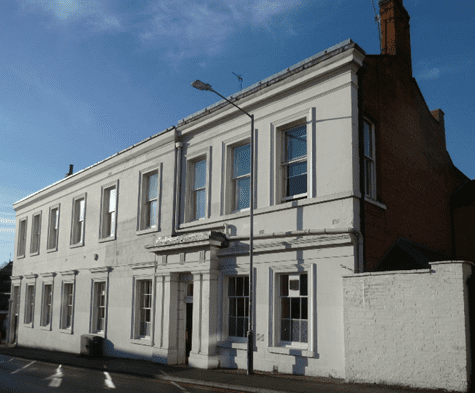
The Tennis Court Club first began negotiations to buy land in Holly Walk to build a home for what the Leamington Courier considered “this scientific and beautiful game” in 1844. Two years and many negotiations later, the courts opened instead in Bedford Street.
‘Real’ or Royal Tennis, as opposed to Lawn Tennis, is an ancient game, dating back to early mediaeval times and the courts of the French nobility and their game of Jeu de Paume, which was not unlike Fives and Pelota, played with the hand, not a racquet. Real Tennis is the ancestor of modern handball and racquet games, and still uses a handmade cork-based ball and a wooden racquet, shaped to make low shots close to the floor playable. The rules of the game are complex, linked closely to the layout of the enclosed oblong indoor court; its lofty ceiling allows very high lobs and its galleries, hazards, buttresses and penthouses create complex trajectories for the balls. At Leamington the Court is a ‘jeu à dedans’, or ‘indoors’, and is a very substantial building, wider and longer than a lawn tennis court, with high level windows, and three walls of sloping-roofed penthouses containing galleries for spectators, – or for scoring points. Service is always taken from the same end.
Real Tennis declined in the 18th century with the advent of ‘rackets’ and ‘squash racquets’, but there was a revival in England during the reign of Queen Victoria. The development of Leamington as a Spa town brought an influx of wealthy visitors with little to occupy their time beyond taking the waters, attending social events, hunting, or tackling the steeplechase course on Campion Hills so sport became popular.
A sporting club of any kind was a rarity at that time, so a tennis club, where the local residents, as opposed to seasonal visitors, could meet as a group, was an unfamiliar idea. Lord Guernsey, Lord Leigh, Lord Somerville, Lord Brooke, Matthew and Henry Wise, Edward Greaves of banking fame, Dr Jephson, and Rev. Henry Des Vœux of Clarendon Square, were founder members, most of whom lived in or close to the town. One obvious reason for this was that matches had to be played in daylight because the court had no artificial lighting, – a problem during the short days of winter, especially if travel had to be factored in. At that time members were served only snacks, not meals, but often stayed until midnight, smoking, drinking and playing billiards or cards. It would be wrong to suggest that members regarded the club as primarily for social gatherings: it was set up first and foremost for the game.
The chosen architect, John George Jackson, Land Agent of Edward Willes, was sent to London to inspect the Haymarket Court, and he earmarked several potential sites, including land belonging to a Mrs Barber in Holly Walk, Regent Place (site of the old Bowling Green), and a site at Lillington (favoured by Des Vœux). Eventually, a site in Bedford Street next to Belsay House was chosen and the owners paid £500 for the land. Mrs Barber received £50 in compensation for the non-completion of the original contract. William Ballard, a local builder and entrepreneur was engaged and it soon became clear that the £2,000 target would not cover both the building and the many legal costs involved (the eventual costs, including buying the land, building, extras, furniture and professional legal fees, totalled £4,561). The founder members pressed ahead.
The Foundation Stone was laid by Charles Earle on 15th July 1846, and the building was completed in under six months. The building is very much of its time: whilst early Leamington favoured the Regency style, the Tennis Court Club reveals an interesting shift, a mid-century period of architectural revitalisation, – and the muscular Italianate style, seen in the window cornices and entablature. The porch is Tuscan. The brickwork front is ruled stucco render, and the glazing bars on the southern wall recall the conservatories which were then so popular.
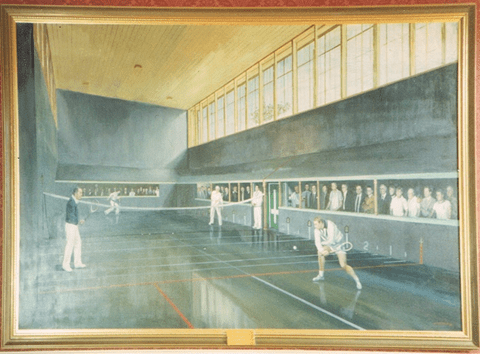
A Board of Trustees was appointed to manage The Leamington Tennis Court Company deed of trust, headed by Lord Brooke, Charles Earle and Henry Christopher Wise. Many of the founding members played regularly when the club first opened, and the novelty value of the new club worked in its favour, attracting a large number of distinguished local characters. One such was a regular player and diligent committee member, the Hon Colonel Sir George Cathcart, a senior army officer who had fought at Waterloo, and who was later to die in the Crimea.
Another early member was the intrepid, eccentric Shropshire Squire, Jack Mytton, – one of the last Regency bucks, said to have consumed six and more bottles of port every day of his adult life, and who unsurprisingly, died at the tender age of 37. Distinguished visitors/players included Peter Tompkins, whose son was employed as marker, and world champion French player, J Edmond Barre.
Fast forward to 2018. There have been fluctuations in financial security, membership and other concerns, and women now play Real Tennis, – rather well! HRH the Earl of Wessex attended the finals of the first Women’s World Real Tennis Championships held at the club in 2015. There are 26 courts in Britain, with about 7,000 players, – and Leamington is now the oldest of its kind. Amongst the laws of the game, the rule that players must “accept success, failure, victory or defeat with good grace and without excessive emotion” still holds strong. This building is Listed Grade II*.
This page is one of many which are based on articles in our book entitled A History of Royal Leamington Spa in 100 Buildings which was published in 2018 and is no longer in print.