
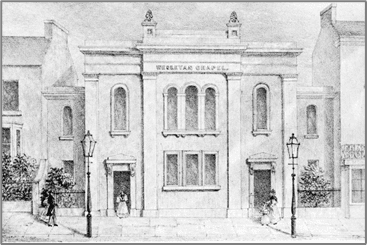
As there was no provision for Methodists in Leamington in the early 1800s, worshippers travelled to Warwick, or further afield to Coventry. A London barber, William Scott, set up a place of worship for Methodists in Barnacle’s Yard, Satchwell Street in 1817. Two years later, with a congregation of just nine, a large room in Brunswick Street was hired and there is also reference to Tower Street Chapel off Clemens Street being used at this date.
Next, a Methodist Chapel in Portland Street, in the area known as Quarry Fields, was established in 1825. This building was extended twice in less than a decade as the number of members escalated, and the adjoining schoolroom was taken over for worship. New premises were urgently required, and a site on nearby Dale Street was chosen. The first Dale Street Chapel, funded largely by members and designed by George Woodhouse in the Italianate style and considered a monument to Methodism, was opened in June 1870.
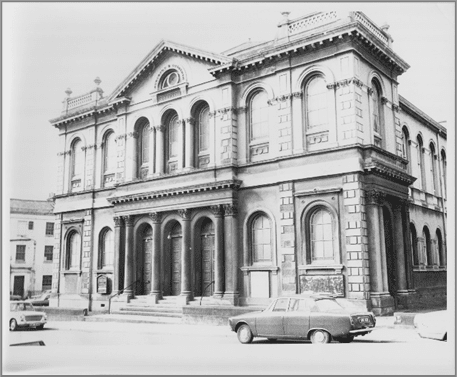
Photo Leamington History Group Archives
New premises were urgently required, and a site on nearby Dale Street was chosen. The first Dale Street Chapel, funded largely by members and designed by George Woodhouse in the Italianate style and considered a monument to Methodism, was opened in June 1870.number of members escalated, and the adjoining schoolroom was taken over for worship. New premises were urgently required, and a site on nearby Dale Street was chosen. The first Dale Street Chapel, funded largely by members and designed by George Woodhouse in the Italianate style and considered a monument to Methodism, was opened in June 1870.
It is noted that a breakaway group of Wesleyans established themselves in Clarendon Street (No 12) from about 1852 to 1863. The building is now apartments. Also a United Methodists Free Church was opened at Nos 118/120 Warwick Street in 1864. It was being used by Primitive Methodists from 1921 to 1972 when it was demolished.
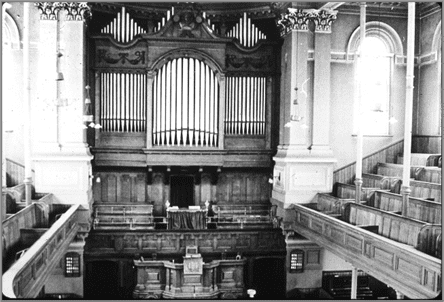
Photo Leamington History Group Archives
Within the Dale Street Church could be found an imposing central pulpit reached by stairs. The organ was located to the rear. In common with many Methodist churches a gallery with several rows of seating ran around the main body of the Church. The larger building could comfortably accommodate a larger congregation, but as the population growth of the Spa declined, and maintenance costs rose, this fine Victorian building became unsustainable.
By the 1970s, as other churches and chapels were facing similar problems, it was agreed to combine forces with the former Primitive Methodists at the Warwick Street Chapel. The proceeds of the sale of the premises in Warwick Street were then invested to update the Dale Street Church. The old Dale Street Church was demolished and a new Church designed by Cripps & Stewart in 1971 was opened in September 1972, capable of seating some 250 members, with the option of opening doors to utilise the adjacent community room. The Neo-Classical 1928 Sunday School by F W H Lee was incorporated into the new arrangements, extending available space even further
The church is a hive of activity, a welcoming space for choirs, badminton clubs, Women’s and Men’s Fellowship, drama groups and prayer groups, Beavers, Brownies, Cubs, Guides, Scouts and Venture Scouts, and many external clubs and societies.
Footnote. The Trinity Wesleyan Methodist Church in Radford Road was built in 1879 to a design by John Cundall. This church had its roots in chapels in Althorpe Street and Court Street. The front was redesigned in 1992 when the Methodists agreed to share it with the United Reformed (previously Congregational) church.
This page is one of many which are based on articles in our book entitled A History of Royal Leamington Spa in 100 Buildings which was published in 2018 and is no longer in print.