
Originally the land on which houses in Aintree Drive were built belonged to Mr S McGregor, who ran a successful stud farm. This is the reason why, after he sold the land for building, many roads were named after racecourses. Valley Road runs through the middle of the estate and on either side are Aintree Drive, Ascot Ride and Kempton Crescent grouped together and Sandown Close and Redcar Close interlinked.
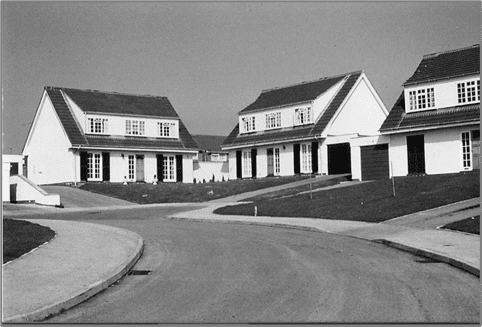
The French House Company who built some of the houses formed the English branch of a French company, La Maison Familiale. They were hoping to break into the English house-building scene and in the later 1970s they had built a few houses in Monks Kirby and Marton, – the Chaumière (Cottage) VIII design.
Thirty-eight French Houses were built on Lillington Stud land and all are either Camerica VII or Camerica VIII design. Both styles are of the same dimensions but the integral garage of the VII becomes a separate dining room in the VIII, with either a double or tandem garage built alongside. All the houses have either one or two sets of French doors at the front of the property, and a further set at the rear. The original staircases had ‘lyre’ boards top and bottom, removable to enable furniture to be carried upstairs.
In France, many houses are built of breeze blocks on raised plots, subsequently clad. As termites can be a significant problem, floors, including upper floors, are often made of concrete. Another ‘French’ feature is shutters on the windows.
Many of the Lillington Stud houses are built raised well above road level, and those of Camerica design are clad. The plots, for England, are generous and as a concession to the English mania for bricks, the Camerica VIIs are unclad at ground floor level. They also have functional shutters. The steeply sloping roof timbers were constructed offsite and transported to the plots on low loaders. A crane then lifted the roof timbers down on to the waiting ground floor structures.
In Lillington, the colour preference was for white rather than the creamier colour of the French Chaumière, followed through in all the external paintwork except the front doors, which were stained wood. As time elapsed, many of the original wooden features have been replaced by UPVC, and the curved ends of the roof have also often been squared off, removing one of the houses’ most distinctive features. Most families have retained the shutters, often stripped and stained for ease of maintenance. As a legal clause forbids householders to build garden walls or grow boundary hedges over 45 cm high, the estate has maintained its open feel. On completion of Sandown Close, Redcar Close, Aintree Drive and a short section of Valley Road, vehicle access from Cubbington Road via Epsom Road was permanently closed and the pavement realigned, as agreed at an earlier date with Mr McGregor.
The difficult financial climate in Britain in the 1980s meant that the final few houses on Aintree Drive were not completed by the French House Company who by this time were virtually bankrupt. Local builders Crosbee & Atkins bought the remaining strip of undeveloped land and proceeded to build eight linked-detached homes in a totally different style, emphasising the use of brickwork and dark woodwork. Many of the original French Houses were taken by IBM employees and, by 1981, were fetching between £43,950 and £47,950, depending on size and position. Although today Groupe Maison Familiale still builds successfully over a wide area in France, the English ‘arm’ ceased trading in Britain in 1982.
This page is one of many which are based on articles in our book entitled A History of Royal Leamington Spa in 100 Buildings which was published in 2018 and is no longer in print.