
There can be a debate about which of Lillington or Leamington Priors parish churches was founded first. There is little evidence either way before the Norman Conquest. The Domesday Book states that Lamintone (Leamington) had a priest and, therefore, probably the existence of a form of church, in 1086; there is evidence of a church in Lillington about 1100. There are articles on both these churches in this book.
In 1166 the manor of “Lemynton” with the church and mill was given to the Augustinian Priory of Kenilworth and the village became known as Lemynton Priors to reflect its monastic connections. A sandstone effigy of an Abbott was dug up near the parish church in Leamington in 1870. 1349 was the year of the Black Death and three Vicars of Leamington died in office in that year.
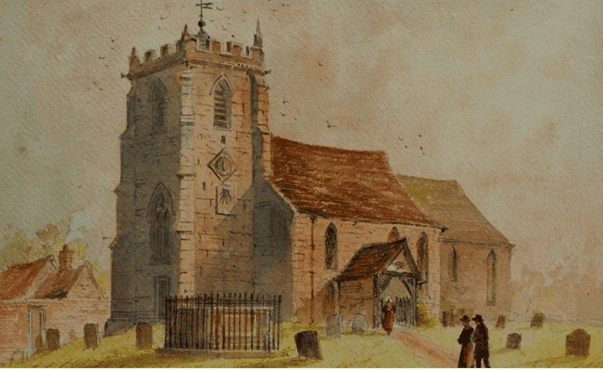
A watercolour of 1810 shows the old medieval church which was described as being “small and rude” and “resembling an Abbey Church in miniature”.
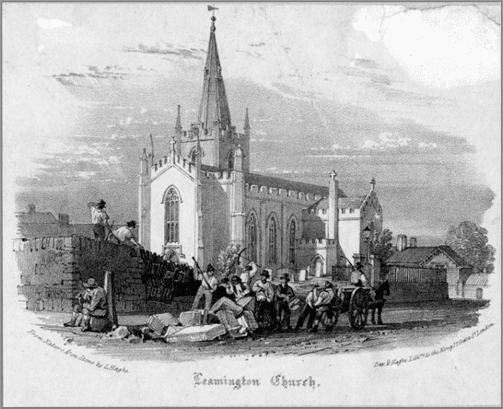
The church was extended in 1816 and the foundation stone was unveiled by James Bisset. An engraving from about 1820 shows the old church and several half-timbered cottages and shops near the West door. There were four bells in the tower. Rev. Robert Downes took over as Vicar from Rev. Richard Lowe in 1823 and commenced a series of extensions to the medieval church to accommodate the huge increase in the number of worshippers as the village grew into a spa town. A spire above the original tower and an extension to the south were parts of his additions. Gas lighting was installed in 1830.
Apart from enlarging the church, Robert Downes also had burial vaults constructed in 1825 on the north side of the church to compensate for the loss of burial space in the churchyard due to the building works. There was space in the vault for 180 bodies and these spaces could be purchased by families or by individuals. The vaults under the North Transept are almost full; the last interment was in 1855. Many of the incised tablets on the vaults are now badly eroded but some are legible. There are cast iron gates and spikes to deter body snatchers from removing corpses to sell to medical schools for dissection by students.
Among those interred in the vaults are some of the town’s wealthier residents and benefactors of the new church. Behind a rusty, cast iron door are the remains of the five Manners-Sutton sisters, daughters of the Archbishop of Canterbury. There is a tomb with railings around outside the present church which marks the burial place of Benjamin Satchwell, the well-known sage, poet and benefactor of the village. The memorial dates from 1812.
Rev. Robert Downes had made substantial changes to the church before he exchanged livings with Rev. John Craig (born 1805) in 1839. Downes continued to live in Leamington until his death in 1859, leaving his parish in Fetcham, Surrey in the care of curates. John Craig paid his predecessor Robert Downes £1,000 principally to compensate him for his loss of income from renting pews. A building opposite the church in Priory Terrace was the vicarage built by Robert Downes and named “The Priory”.
‘Johnny’ Craig was an Irishman by birth and he had a considerable fortune which he planned to lavish on building projects in his new parish. A local journalist of the time, George Morley, reported that in a period of twelve months Craig had an income in excess of £100,000. Craig was variously described as learned, eloquent, generous and eccentric in mind and body; with his spare figure and rapid, tottering gait he was a familiar sight and one of the great characters of Victorian Leamington.
Collection of Alan Griffin
He soon outlined his plans to demolish the small medieval church and to build, mainly at his own expense, one of the largest parish churches in England which he himself would design and that is what he nearly achieved. Edmund Mitchell, J G Jackson, T C or T D Barry and John Cundall were some of the architects involved and the style has been described as Continental Gothic. Unsurprisingly, the project was dogged by controversy and by Craig’s insistence on being his own Architect and Clerk of Works. The church was still not completed when he died nearly 40 years later, in 1877.
Craig’s designs were for the new All Saints to have a central tower and a spire almost three hundred feet tall with a separate Angel Tower and a campanile for the bells.
Not long after his arrival, John Craig began something of a charm offensive in the town. In a series of meetings in the old Town Hall in 1842 he outlined his aspirations and showed drawings of the proposed new church.
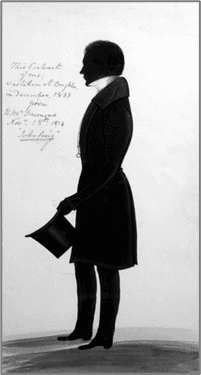
Image Leamington Spa Art Gallery and Museum
While the parishioners were not opposed to his ambitious plans, their main concern was to ensure that should funding fall short of his expectations, the churchwardens would not be called on to make up any shortfall from the church rate. Such assurances were given and the required faculty for the works was granted by the Bishop of Worcester.
Construction work began in the late summer of 1843 when the foundation stone for the lantern tower was laid. Work also commenced on the nave with monies from pew rents covering some of the cost. The old church tower was left in situ as a support for the scaffolding required for the construction of the new nave roof. The new nave opened for worship in May 1844 and work then began on the chancel and the east windows.
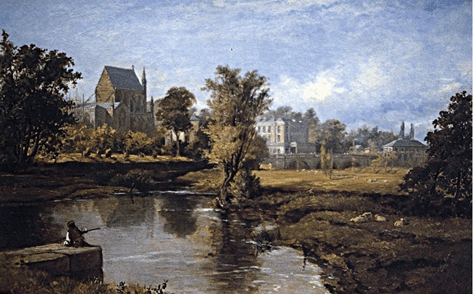
The watercolour above, by noted Leamington artist Frederick Whitehead, shows the scene in 1844 from the banks of the river Leam. The nave of the new church rises above the north transept of the old church.
Craig’s publicity machine again went into overdrive in June 1846 when he laid on a dinner for 350 residents at Elliston’s Music Hall in Bath Street (now named the Parthenon). The Angel Tower was built in 1849. Work then began on the north transept but the whole project ground to a halt in 1849 and for the next eighteen years no construction of any sort took place.
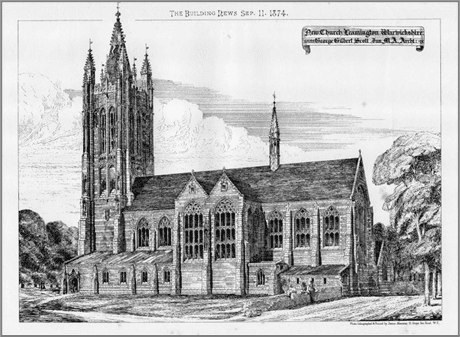
The 1850s were difficult years for the irrepressible Craig. He had had to abandon his grandiose designs for a church with three towers when the nave columns were discovered not to be substantial enough to support the weight of a tower and spire over the crossing. Although the part-built church could now seat two thousand worshippers, parts of the building, mainly the south transept, were still far from finished and the roof of the nave let in the rain.
Craig’s lofty tower and spire were never built and there is still a raised square section of flat roof above the crossing where they should have been. Both Craig’s wife Helena and his only son Robert died in the 1850s and he was himself in poor health. He became embroiled in law suits relating to his handling of monies for the church rebuilding and was imprisoned for a month in Warwick jail for alleged misappropriation. In spite of all these setbacks Craig still found time to indulge another of his interests, astronomy, by building on Wandsworth Common in London one of the largest telescopes in the world at the time.
Although John Craig still legally held the living, his involvement in All Saints was greatly reduced and his curates were left to oversee the affairs of the parish. The parishioners had by this time become very fed up with having to attend divine worship in a building site for twenty years and they wanted to see the building finished.
An “iron church” made of corrugated iron was erected in 1861.
The church was even closed for a period in 1866 as the temporary roof was found to be in a dangerous condition. A church completion committee was set up but its members could not agree and replacement members had to be found. Competitions were eventually held for schemes to finish the building. In 1870 John Craig’s third wife Jane died. Craig soon became seriously ill and died at the vicarage in 1877 after a long and painful illness which necessitated having one of his legs amputated. His funeral was the largest ever seen in Leamington and ten thousand people lined the roads to the cemetery in Brunswick Street.
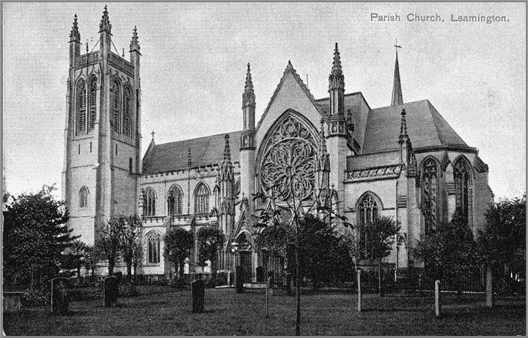
Around 1866 there was an organ on a balcony above the west door and galleries in the north transept. These were removed after the church was extended by Sir Arthur Blomfield in 1900.
The building that had emerged towards the end of the 19th century was of impressive proportions but there was no provision for the church bells which had hung in mute silence in a temporary wooden belfry in a corner of the churchyard for over fifty years.
The church was hemmed in by houses built in Church Walk and by a row of terraced shops in Bath Street within a few feet of the west door. In the 1890s the church purchased the shops in front of the west door and on the north side of Church Walk and had them removed. The old well house had been erected by the Earl of Aylesford nearby in 1813 but that was demolished in the 1960s and a sculpture in the form of a spray of water was erected on the site some years later.
The Rose window on the south side is based on the one dedicated to St Ouen in Rouen; the Wheel window on the north side follows the design of one in Rouen Cathedral. They both date from about 1870. The first recital on the new organ with 1690 pipes was in 1879.
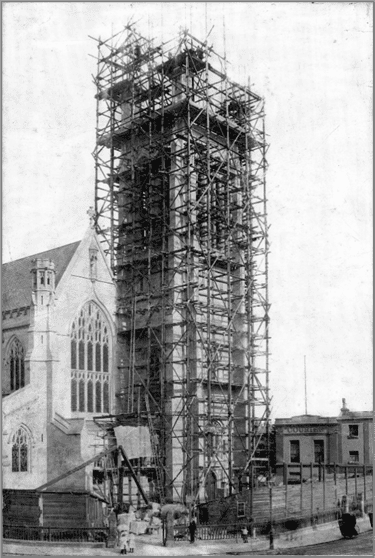
Rev. Hook was at the Parish Church for nine years from 1896; he combined the proprietary chapels of St Alban’s, the Good Shepherd and Christ Church with the Parish Church. In 1898 the eminent architect Sir Arthur Blomfield was commissioned to draw up designs for the completion of the church almost fifty years after construction work had first begun. This involved the removal of the balcony above the west door, the galleries in the north transept and adding two additional bays and a bell-tower, 145 feet tall, at the west end of the nave. The enlarged nave was dedicated on All Saints Day (1st November) 1900 and the bell tower on 30th October 1902. The earlier sandstone used by Craig was poor quality and turned quite black due to atmospheric pollution.
There is clear difference between the clerestory windows and the nave arches of Craig’s design and those added by Sir Arthur Blomfield in 1900. The three tall windows in the apse, said to be the tallest in any parish church in England, were made by Chance Brothers of Smethwick and given in memory of the five Manners-Sutton sisters who lived in Leamington. The chancel screen was designed by Blomfield and was given by Alderman Sidney Flavel. The carved stone reredos behind the high altar was given by the Willes family from Newbold Comyn and is based on Leonardo da Vinci’s famous painting of the Last Supper.
Leamington Spa Art Gallery and Museum
John Craig had many endearing qualities but, unfortunately, his greatest failing was his arrogance. There was scarcely a subject about which Craig didn’t hold an opinion or express expertise in, and that included buildings and architecture. Many of his design ideas for the new church were not carried out because they were quite impractical. He is said to have employed and sacked eleven different architects during the building of the church and at length appointed himself Clerk of Works for the project.
Of his many misjudgements due to a lack of professional advice, by far and away the biggest mistake was in his choice of local Warwick sandstone for the building. Warwick sandstone is very soft and one of the poorest building stones available. Within thirty years the local newspaper was reporting on the “lamentably decayed condition” of the church stonework. Rev. Armstrong Buck had the difficult task of having to raise over £3,000 for urgent repairs to the fabric in 1907 and he is on record as saying that in his opinion the best solution to the problem would be to pull the entire building down.
The Urquhart Room at the west end of the church was designed by Rayner and Fedeski and opened in 1986.
Over the years, huge sums have been expended and continue to be spent on the fabric of the church which currently requires several million pounds for urgent repairs and was likely to be included in the English Heritage ‘Buildings at Risk’ register for 2013. The estimated repair cost in 2012 was £6.8 million. In 2014 25% of the old stone needed replacing and one-off money was received from the government roofing fund. The maintenance cost was said to be more than £30,000 per year.
An application for £250,000 grant for the south windows was refused in September 2017. It has been estimated that the cost of outstanding repairs totals £8 million in 2018.
The church is Listed Grade II*.
This page is one of many which are based on articles in our book entitled A History of Royal Leamington Spa in 100 Buildings which was published in 2018 and is no longer in print.
ACKNOWLEDGEMENTS as presented in the book