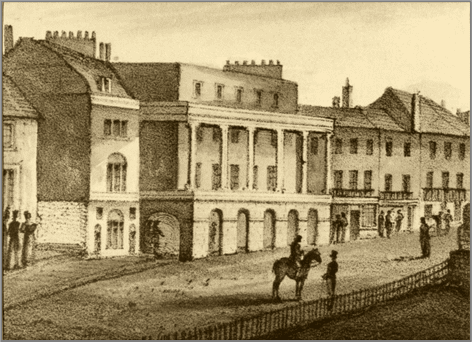
As the town became a fashionable spa, people needed entertainment when not taking the waters. Bath Street was close to several baths in the town and in 1814 John Sims opened a theatre there, opposite Abbotts’ Baths. Two years later Robert William Elliston (1774-1828), an actor-manager from the Theatre Royal in Drury Lane, London took it over. He then built the new building which was to become The Parthenon in 1821. These Lower Assembly Rooms, designed by Samuel Beasley, cost Elliston over £25,000, (or £1.5 million in 2017).
The Parthenon had a central block with a smaller wing either side. Straddling the footpath was a double-storeyed arcade, 13 feet wide by 42 feet long. Below were six rusticated piers and above were six Ionic columns supporting a cornice. Legend has it that when the portico was demolished in 1853 the columns were moved to Spencer Street Chapel but this has not been authenticated.
The ground floor had the Repository selling stationery and music with pianos for hire. This led into the Library with 12,000 volumes and a Reading Room. Below the ground floor were bookbinding and printing offices where Elliston published works by local writers. The Assembly Rooms, with a Tea Room and a Card Room, were on the first floor. The ballroom, lit by ten huge ormolu gas chandeliers was 83 feet long by 31 feet wide and 30 feet high and had a powerful organ. It was decorated with copies of the frieze from the Parthenon which later gave the building its name.
The Assembly Rooms became a popular venue for music events, partly because its proportions created an excellent acoustic. Mrs Elliston was an experienced teacher of dance and she set up a school of dance. Around 1825 summer balls took place weekly in both the Upper and Lower Assembly Rooms. After Mrs Elliston’s premature death in 1821, two of her daughters continued the Dance Academy.
A Balloon was exhibited at Elliston’s Assembly in 1824 and later ascended from the Bowling Green in the heart of Old Town. Sadly, in spite of such ventures, Elliston’s business suffered fierce competition. He declared himself bankrupt in December 1826. Following this, the Parthenon passed through several different hands including Elliston’s sons, Henry T and William G Elliston.
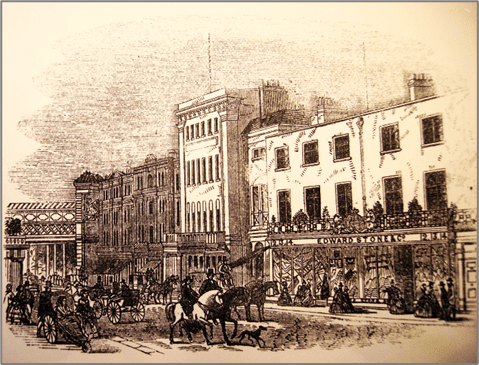
When it reopened in 1828 it was called the Royal Assembly Rooms although the town itself did not become Royal until 1838. William Elliston emigrated to Tasmania in 1831, where he prospered in local politics. Henry Elliston again sold the Parthenon in about 1833 and closed the Theatre in Bath Street but in 1835 he took on the Parthenon yet again. Despite opposition, he removed the top portion of the portico saying that it obstructed the light into the building. Although under Henry the Lower Assembly Room was called the Royal Music Hall from 1838 it was commonly called ‘The Parthenon.’ The ground-floor library continued under various librarians. Dances were only held if enough people subscribed in advance. In 1839 there was a visit of General Tom Thumb who was 3 feet 4 inches tall and weighed 71 pounds; he left the Hall in his miniature carriage drawn by “the Smallest Ponies in the World.”
The use of the ground floor also changed. In 1839 it housed the offices for N L Torre, Eliza Elliston’s husband, who was an insurance agent. By 1846, William Enoch’s repository and library occupied No 16 Bath Street, one of the side wings of the building. The central part, No 17, was leased to John Dowler, a decorator and upholsterer.
Competition for the business arrived in 1849 in the form of the Victorian Equestrian Centre at the end of Victoria Colonnade. By 1861 Nos 17 and 18 were used as Wackrill’s furniture warehouse. The Leamington public library at the corner of Church Walk and Bath Street, where Henry Elliston was appointed librarian in 1863, had outgrown these premises by 1864, so part of the Parthenon was leased to accommodate the overflow. In 1875 Bath Street was renumbered. Numbers 16, 17 and 18, the Parthenon, became 50, 52 and 54. In 1892 the shops, Nos 50 and 54, were occupied by J Jones, trunk maker, until at least 1896.
On the ground floor of number 52 in 1896 were Blackburn & Co, clothiers.
Well into the early 1900s the upper floor of the Parthenon continued to be known as the Royal Music Hall, managed by Mr A White. In the late 1890s the cinema began and the first of regular shows held in a permanent building in town were at the Parthenon. This had various names including White’s Electric Theatre and the Spa Cinema. The cinema closed before 1924 when the building was again known as the Royal Assembly Rooms and Spa Café (later the Blue Café).
Mrs M M M Fowler OBE leased the Blue Café which included the Assembly Rooms with double entrances from Bath Street. The ballroom measured 65 feet by 32 feet. There was also the café, a lounge, offices and kitchen. By the 1930s No 54 was Home & Colonial Stores, grocers, and No 50 was a double-fronted shop. The Parthenon had outlived the Upper Assembly and the Public Hall in Windsor Street.
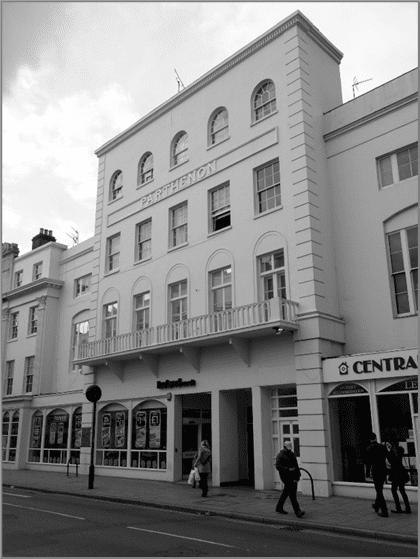
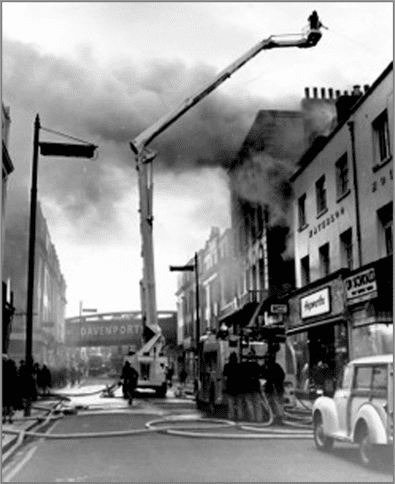
Even though Listed Grade II in 1953, the Assembly Rooms gradually deteriorated throughout the following decade and were partially destroyed by fire in January 1968. In 1970, the building was demolished and the front rebuilt in the style of the original but without the columns; it kept the name ‘Parthenon’ across the top front. The rear was rebuilt in modern style. A proposal for an indoor market was shelved in 1976 amid fears that it would be overshadowed by a new shopping development in Upper Parade. From 1975 to 1988 Bejam Stores occupied the ground floor, selling mainly frozen foods. The Parthenon is occupied by Iceland in 2018 and the street-level frontage is a modern glass shop front.
See also the articles on the Upper Assembly and Bath Assembly.
This page is one of many which are based on articles in our book entitled A History of Royal Leamington Spa in 100 Buildings which was published in 2018 and is no longer in print.
ACKNOWLEDGEMENTS as presented in the book