
The expansion in the population of Leamington Spa brought with it the challenge of treating sewage, a subject not often recognised. It was common practice in the 1850s to allow such effluent to be discharged into the nearest watercourse or river, with the attendant risk of spreading infectious diseases. Other sources of contamination were from supplies of water from wells as piped clean water was not common-place. Safe sewage treatment and a wholesome water supply became the focus of the Leamington Local Board of Health which was established about 1848. The Board consulted Thomas Wicksteed, a notable civil engineer of his day, specialising in efficient sewage treatment works. In reporting to the Board he recommended the use of what is now called Victoria Park, but described as Jubilee Park in his proposals. The scheme was not progressed. On 11th May 1871 members of the Board along with others gathered at the Sewage Works to witness the laying of the corner stone of the chimney stack intended to serve the new boilers in the boiler house on the south west side of the site. The ceremony was performed by Dr Thomson, the Chairman of the Board. In his address he stated that the sewage works were of vital importance to the community and that the prosperity of Leamington was intimately connected with the local sanitary arrangements. At this time the works were known as the Leamington Sewage Irrigation Works.
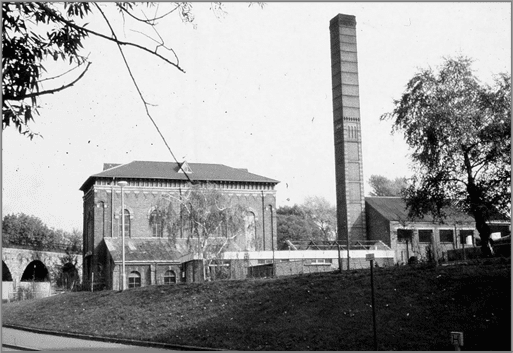
Dr Thomson went on to describe the installation including a pair of condensing beam engines, each capable of pumping 1,500,000 gallons of sewage in 12 hours. The engines would be supplied by Joseph Clayton of Soho Foundry, Preston, to be installed at a later date. It was proposed to have a reservoir constructed alongside the canal with a holding capacity of 800,000 gallons, the ‘present’ tanks holding approximately 200,000 gallons. The contract for construction of the reservoir and buildings including ‘a pair of neat cottages’ had been awarded to Mr. William Green of Leamington. The sewage would be conveyed by means of cast-iron pipes some two and a quarter miles in length to a sewage farm which was in the course of preparation by the Earl of Warwick. The pipes were to be supplied by Messrs. John and Samuel Roberts of West Bromwich to be laid and pointed by Messrs. William Gascoyne and Sons of Leamington. Dr Thomson indicated in the detail that provision had been made to deal with effluent from Milverton and Lillington and they would be expected to pay their share of the expenses.
In the discourse it becomes apparent that once the sewage had reached the Earl of Warwick’s land he became responsible for its disposal for the ensuing 30 years. The usual formalities associated with such events followed, including Dr Henry Jephson requesting three cheers for the assembly. He was described here as “The Father of Leamington”.
Eventually the works were completed and the whole plant commissioned to serve the increasing population of Leamington Spa. This growth prompted the need to increase the pumping station’s capacity to deal with sewage with the installation of a new horizontal pumping engine in an engine house erected at the side of the old engine house. In 1917 an engine manufactured by James Simpson & Co. of Pimlico in London was installed. It was around this time that the original Lancashire boilers were scrapped and replaced by two water tube boilers enabling the town’s refuse to be used as fuel. It is understood that the beam engines were scrapped in the 1920s. The cast iron columns which supported the beams remained in situ until the late 1970s.
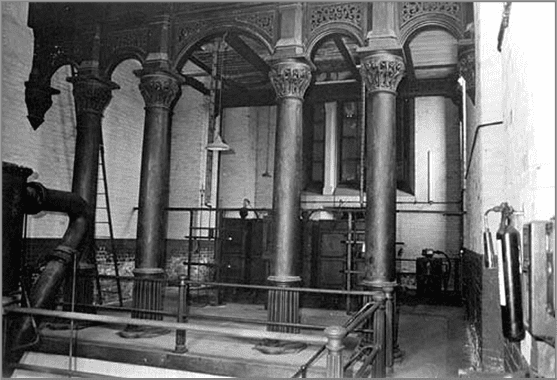
Photo from Collection of Peter Coulls
In 1928 five electric pumps and associated steam-generating engine were installed in the former beam engine house. The pumps were provided by Wallwin of Warwick and the enclosed engine by Bellis and Morcom of Birmingham. This system enabled an alternator to provide additional lighting and power to ancillary plant outside. The station continued to function until 1965, when eventually the boilers, boiler house and chimney (not the original one) were demolished. The five electric pumps continued to operate until 1977 when new underground electric pumps were commissioned rendering the old engine house redundant.
Proposals to preserve the station and engines were made to the Severn Trent Water Authority by a group of local enthusiasts in 1978. The project was rejected as the site and equipment were to remain operational by the Water Authority. However some elements of the pumping station have been preserved; the support columns from the original beam engine house can be found at the entrance of the Blists Hill Victorian Town at Ironbridge Gorge Museum, Madeley, Shropshire; the Bellis and Morcom generating plant was on display in the Snibston Discovery Centre, Coalville, Leicestershire until it closed in 2017. It is understood that a 1917 James Simpson & Co. engine has also been saved and is in store at the Crossness Sewage Pumping Station (a preservation site) in south east London.
The whole site with incinerator was commonly known as The Destructor.
This page is one of many which are based on articles in our book entitled A History of Royal Leamington Spa in 100 Buildings which was published in 2018 and is no longer in print.
ACKNOWLEDGEMENTS as presented in the book