
The Regent Hotel opened on 19th August 1819, – amongst the earliest of the buildings erected north of the River Leam as the Spa expanded. On a triangular plot, it was wedged between Regent Street, the Parade, and what later became Regent Grove and the site of the new Town Hall. The land had once belonged to the Greatheeds, and Bertie Greatheed’s granddaughter represented the family at the laying of the foundation stone in July 1818. ‘The Regent’, designed by C S Smith, was thought to be amongst the largest in Europe, and for many years remained the largest in Leamington. It could certainly claim to have the largest ballroom in Leamington.
The first owners were John and Sarah Williams, former butler and housekeeper to the Greatheeds, who had left their service to take the tenancy of the nearby Bedford Hotel which flourished under their direction. The Regent, also known briefly as Williams’ Hotel, opened with a stylish banquet for two hundred people, – many of them titled, and all men, of course, as was then the custom. A ticket cost £1.11s.6d for a menu which included delicacies such as turtle and venison. The Williams’ proudly proclaimed that there were 100 bedrooms, and a bathroom, – but that would hardly have been problematic, when slipper baths and hip baths were in daily use, and guests travelled with their own servants to attend to such things. It still required a staff of 60, however, to run the hotel and the stabling and carriage facility, – 100 horses and 100 carriages could be accommodated.
There was a large dining room, a drawing room, numerous private suites and a coffee room. The dining room looked out on to a small garden to the north, now the site of shops and offices.
W T Moncrieff, in The Visitor’s New Guide to the Spa of Leamington Priors (1822 edn) relates how, on a ‘whistle-stop’ tour of Leamington with the Countess of Warwick and others, in September 1819 the Prince Regent visited the libraries, the Pump Rooms and the Assembly Rooms, cheered to the hilt by townspeople wherever he went. He then graciously granted permission for Williams’ Hotel to be renamed “The Regent.” The royal coat-of-arms was swiftly erected above the main entrance on the south side, where it can still be seen today. The Parade entrance was not constructed until the 1840s, at the request of the Warwickshire Hunt Club, giving them access to their private suite of rooms.
John Williams retired in 1834, to Denby Villa (now the site of the Town Hall and Denby Buildings). Not long after the famed visit of Princess Victoria and her mother, Sarah Williams had died in 1830 and John in 1843. From 1834 until 1874, the hotel was run by licensees appointed by John Williams or his executors. From 1874 until 1904, when John Joseph Cridlan took over, the hotel was owned and managed by a Mr Lyas Bishop. The Cridlan family still owned the hotel when it finally closed at the end of December 1998. There were two large ‘heritage panels’ in the foyer which named many people who had been guests at the hotel and these have been reproduced in modern form in the refurbished premises. Some names that may be familiar include Private Henry Tandey (awarded the VC (see Angel Hotel)), H W Longfellow (poet), Ulysses S Grant (US President), Ellen Terry and Sarah Bernhardt (both actresses), Winston Churchill, Douglas Fairbanks (actor), Sir Bernard and Lady Docker (industrialist and celebrity) and Sir John Sainsbury (grocer).
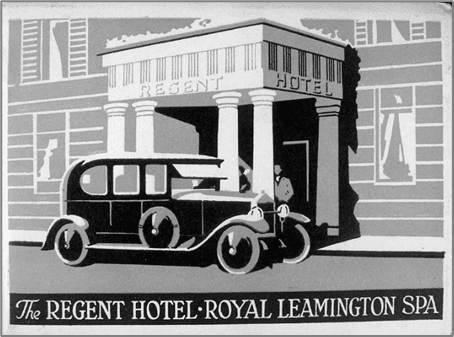
Leamington History Group Archives
The Grade II* Listed building stood empty for two years, its contents auctioned off, as developers’ £30 million plans to demolish and replace with flats, a shopping mall, underground car park and cinema complex abutting Regent Grove, met with fierce opposition from local townspeople, historians and conservation groups who wished to see a fully-functioning hotel retained.
Five rejected development plans later, a compromise was eventually reached, whereby part of the original building was retained, adapted as a Travelodge to meet the needs of the 21st century travelling public. The service wings, the outbuildings and the former stables which had become Regent Garage, were demolished to build Livery Street, running from Regent Street to the Parade. At the outset, Livery Street offered a variety of commercial outlets, but is now a food court, where specialist restaurants present the cuisine of most European countries, and many beyond. It is also known as Regent Court.
This page is one of many which are based on articles in our book entitled A History of Royal Leamington Spa in 100 Buildings which was published in 2018 and is no longer in print.
ACKNOWLEDGEMENTS as presented in the book