
Leamington is justly renowned for its Regency elegance, its squares, crescents and the Parade. However, after the glamorous early days of the spa town, it settled into middle-class respectability and residential life. The coming of the railway in the 1840s supported both visitors to the town and an increasing number of commuters, wealthy manufacturers and businessmen from Coventry and even Birmingham, as well as a fair share of straitened genteel folk and retired military men who settled here.
The development of New Milverton was an important element in the suburban growth of Leamington Spa. The new town, largely laid out on land belonging to Edward Willes, rapidly spread north and west of the river Leam towards the Bins Brook, the boundary with Milverton parish. By the 1820s Bertie Greatheed, a major landowner in the parish, was keen to realise the potential of the situation. In 1824 he sold Long Close, a field to the west of what became Beauchamp Square and to the south of the Lillington to Warwick Lane (now Rugby Road), for development. This was the area between Union Road and Stamford Gardens. It was not until the 1890s that the Percy family (successors to the Greatheeds) sold land north of Rugby Road. By this time, St Mark’s church had been built (1879) to serve the growing suburb, which was officially absorbed into Leamington Spa in 1890. Milverton Boys’ School, at the Leamington end of Rugby Road, was built in 1887, a second building was added to the east in 1892 and the whole became the Milverton Board Schools in 1893.
In January 1895 Lord Algernon Percy sold a piece of land to the west of the Milverton Board Schools to Thomas Bailey, for £450. Bailey was a speculative developer and had already obtained planning permission in October 1894 to erect four terraced houses on the plot; the architect was F Foster. (He was probably Frederick Foster, the designer of the bandstand in the Pump Room Gardens, the tea rooms, later aviary and now again the café in Jephson Gardens, and houses in York Terrace.) In May 1896, Bailey raised a mortgage of £800 from Martha Ann Wall on the security of the unsold property and part-erected houses (numbers 40 and 42 had already been sold).
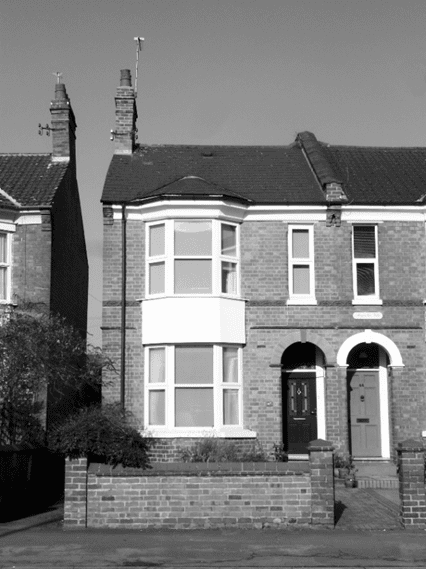
The first occupier of what is now 46 Rugby Road (formerly known as ‘Coten’, 4 Eastbourne Terrace) was Charles Henry Jenkins, an auctioneers’ clerk, born in Soho, London. In 1901 and 1911, as well as Charles, his wife Kate and sons Frank and Herbert there was a live-in maid, Catherine Picher, in the house. In 1891 Charles had been living at 108 the Parade with his widowed mother-in-law Emma Shepherd, a boot and shoe manufacturer; Catherine Picher was even then their servant. His wife Kate bought the property in her own name in 1919, although Charles Henry did not die until 1927. Their son, local historian Herbert Mansfield Jenkins, lived here until 1959. Successive owners were Reginald Howard Champion (1959), Rusi Dorab Mogrelia (1980), Andrew and Jennifer Patrick (1981), Walter and Marjorie Petherick (1990) and Christopher and Sylvia Pinches (1997). The ground plans for the four houses, held at Warwickshire County Record Office, show the four houses, apparently all identical. All four have bay windows and front and back gardens, and the elevations and floor plans show cellar, ground and first floors, and that numbers 44 and 46, built last, actually had a second floor. This was achieved by lowering the height of the back sitting room and back bedroom ceilings, thus creating a half-landing at the back, providing a bedroom with rear window and a box room with skylight on the second floor. This room was extended into a bedroom with a raised area above the landing ceiling by pushing back the attic wall and inserting a stud wall, probably sometime in the 1970s or 1980s. Sometime before 1997 it was converted into a shower room and toilet. On the first floor, the original bathroom and WC was divided into two rooms at some unknown date and remain [2017] separate. The original kitchen on the ground floor, with adjacent scullery, with sink and ‘copper’, had, by 1997, become a dining room and small kitchen. In 2008 these two rooms were modified by the removal of the back two walls and an extension over the original back yard and outside toilet, to create a large kitchen dining room. The building works at this time revealed the old soft-water cistern, referred to in the deeds on 7th August 1895 to be shared with ‘Bemerton’, to the west, along with the four-foot wide passage to the Rugby Road. Otherwise, the house remains substantially as built in 1895. Mr and Mrs Pinches bought the house in 1997 and were given the deeds. Sylvia Pinches set about putting together a little ‘house history’ of when it had been built and who had lived in it. Sylvia recorded the other four owners following the Jenkins. In 2017 Sylvia began to read Jean Field’s biography of Mary Dormer Harris, the historian of Coventry, who happened to have lived further down Rugby Road, and was startled to read the following:
Herbert M. Jenkins who lived with his mother at 46 Rugby Road, Leamington first met MDH after the First World War when he admired her work and found that she lived nearby. They went on long walks together in the 1920s and later MDH often visited his home, jokingly referring to him once as “a walking encyclopaedia of the Warwickshire families’. Sharing a great interest in the Dugdale Society, Herbert Jenkins gave a lecture in Leamington in 1931 on “Dr Thomas’s edition of Sir William Dugdale’s Antiquities of Warwickshire” and this was reprinted by the Dugdale Society as “Occasional Paper Number 3”.
As Sylvia Pinches was at the time preparing her lecture for the Dugdale Society, which was published as Occasional Paper Number 47, she found this particularly spooky. She could almost feel the pair of them standing behind her shoulder, encouraging her to do well!