
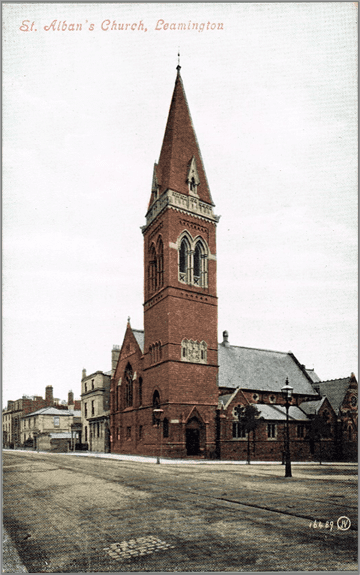
St Alban’s Church stood at the corner of Warwick Street and Portland Street. Its most distinguishing feature was a copper-coated spire. According to historian, T B Dudley, St Alban’s has had the most eventful history of all the Leamington churches. In 1861 the Rev. J Craig, vicar of All Saints erected a corrugated iron building in Priory Terrace. This corrugated iron chapel became known as the “New Opposition Church” or the “Vicar’s New Shop”.
The actual building was sold in 1864 to the Rev. TS Millington, Rector of Woodhouses Eave, Leicestershire and moved to a new site on the corner on Warwick Street and Portland Street, where it became known as the Iron Chapel. The site to which it was moved was a rather beautiful garden belonging to Orleans House. Orleans House was at that time the Working Men’s Conservative Club.
A chancel was erected just before the Rev. Craig repurchased the building in 1865.
Craig continued his ownership until 1871 when it was purchased by the Rev. W Wilkinson, Vicar of Sutton, St Michael in Hereford. Appeals were then made for funds to erect a new church. The appeals were successful and in June 1877 worked commenced with Mrs G Unett laying the foundation stone and a sermon preached by the Hon. and Rev. JW Leigh. The resulting brick-built church was designed by local architect John Cundall and renamed the Church of St Michael and All Angels.
However, in 1882, a Rev. Dr Nicholson purchased the church. Dr Nicholson was originally the vicar of Christ Church, known as the Leamington Episcopal Chapel and situated in Beauchamp Square. He had been given notice to quit Christ Church in 1881 by the new owner, Alderman Dale of Warwick. Dr Nicholson and his congregation then moved to the Public Hall in Windsor Street where services were held until 1882 when Dr Nicholson purchased St Michael and All Saints from the Rev. Wilkinson for £5,600. He then changed the name of the church to St Alban the Martyr’s.
In 1887, a tower was erected to celebrate the jubilee of Queen Victoria. When Dr Nicholson died in 1902, St Alban’s ceased to be a proprietary church and passed into the care of the Leamington vicar at All Saints. In 1911, a church room was added and in 1913-4 the chancel was extended another three feet into the nave. A hut was erected in 1920 enlarging the Sunday School accommodation.
By the 1930s, St Alban’s was an Anglo-Catholic church, which drew its congregation from as far afield as Stratford on Avon. It had a glorious copper-coated spire which glistened in the sun, but later turned green as copper often does in the air. Also, and most unusually, the church was never consecrated. Originally, the consecration had been delayed until the building debt was settled. However, this was not achieved until 1920 by which time the church was so successful it was decided not to bother with the consecration. After the Second World War the church congregation declined, especially the Sunday School, as the local slum clearances moved people away. The church was finally closed in 1964 and the building demolished in 1968, to be replaced by St Alban’s House – a rather ordinary office block which remains to this day.
Michael Pearson, 2018
This page is one of many which are based on articles in our book entitled A History of Royal Leamington Spa in 100 Buildings which was published in 2018 and is no longer in print.
ACKNOWLEDGEMENTS as presented in the book