
Leamington has six parish churches of which All Saints (see article) is the oldest. All of these churches remain in use today. Also during the 19th century Leamington had large numbers of proprietary and daughter chapels but all of these have been put to other uses or demolished (see article on St Alban’s).
The provision of these chapels provided the extra capacity for worship that was needed at the time. However when the demand declined in the twentieth century they were far easier to close than if they had been parish churches.
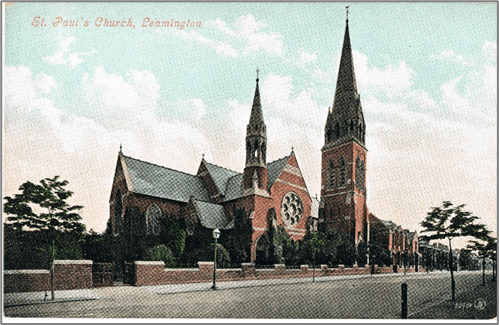
One of the churches that did survive was the parish church of St Paul’s in Leicester Street. This church was built in the early 1870s in response to the demands of an increasing population for a place of worship in north east Leamington and its parish was formed by dividing St Mary’s parish
The building of St Paul’s church was considered during July 1872. The Vicar of St Mary’s, the Rev T Bromley, issued an appeal for the necessary funds and a committee was set up to oversee the building work. A Mr Samuel Bird offered a plot of land in Leicester Street and a purchase price was agreed of £533.15s.0d. In August, £3,212 had been subscribed towards the £5,000 required for the building.
The style of the building was to be 13th century Gothic. Mr John Cundall, a local man and soon to be the designer of Leamington’s new Town Hall, was appointed to be the architect. The committee instructed Cundall to make the church plain and inexpensive with very little carving or ornament.
By December 1872, Mr Cundall informed the committee that he could build the Church for £4,000 excluding the chancel and the whole for £5,000 if the tower and spire were left for a later date.
The committee were very anxious to open the church free of debt and it was with some misgivings that they eventually commissioned Thomas Kibler of Wellesbourne to commence the building of the church in February 1873 at an estimate of £6,240.
The foundation stone was laid by Mr William Willes of Newbold Comyn (son of Edward Willes, who gave Jephson Gardens to the town) on May 15, 1873. The foundation stone reads “To the Glory of God. This foundation stone of St Paul’s Church was laid by William Willes Esq on 15th May 1873”.
This foundation stone contains the only public reference to William Willes and is still in existence today although in a poor condition.
The nave, aisles and transepts were built first but there was insufficient money to build the chancel and vestries. In order that the building could be ready for its planned opening in May 1874, the Rev. Bromley agreed to foot the bill.
The tower and spire construction was started in February 1874 after £1,196 was raised. This was completed in 1875 in accordance with Cundall’s designs although in slightly different materials. When completed the church was 130 ft long and 86 ft wide with a 150 ft spire. There were galleries in the transepts, set back so as not to project into the nave. Of the 1123 seats, 146 were in these galleries and 500 of the seats were free.
As noted, the tower and spire were not included in the original building plans and to compensate for their omission a turret was built at the corner of the north transept, with space for one bell and capped by a stone spirelet. The first storey of the tower was intended to form the north porch and principal entrance to the church, through an outer door set in a richly moulded arch. Until the tower was built the church was entered by doors in the north transept and at the west end through a porch. This was removed when the school and other rooms were added in 1887-8.
The church was not consecrated at first, being only dedicated for services. It was not, therefore, regarded as an independent parish and as a consequence its minister was under the jurisdiction of the vicar of St Mary’s. The church was opened with the dedication by the Bishop of the Worcester on Ascension Day, 14th May 1874. A great celebration was held in St Mary’s School, Holly Walk (later renamed St Paul’s) when the Rev. Bromley was congratulated for building the church free of debt with a surplus of £2.16s.11d following the settling of all accounts in April 1875. A remarkable achievement considering the final cost which came to £9,000.
Around the time of opening Rev. Bromley approached William Willes about purchasing land to the west of the church for ancillary buildings including a church hall. The bid was successful although the Rev Bromley died before the work was completed in 1888. W. Hawley Lloyd of Birmingham and Leamington was the architect, with the Rooms and House built in a Jacobean style.
Initially the Rev Bromley supervised the services with his assistant ministers at St Mary’s, the Revs J H Rogers and D C Hunt. In 1876 the Rev. W Flory took the place of Rev Hunt and continued in office until his acceptance of the incumbency of Holy Trinity in 1877. The Rev. Bromley then continued with the Rev. H MacDonald as his assistant curate. Unfortunately, the Rev. Thomas Bromley, who had done so much to build St Paul’s, sadly lost his wife and three sons in the years 1881 to 84, the eldest dying in a railway accident near Manchester. This undermined his health and he eventually resigned.
The church was finally consecrated on 25th May 1878 and allotted a district. An endowment was awarded of £200 per annum. The Rev. MacDonald’s successor, the Rev. J Bradley of Walsall was presented to the living in July and then remained at St Paul’s for some 15 years before retiring in 1893 due to ill health to be succeeded by the Rev. G E A Pargiter, formerly of Yarmouth.
The church, with its later additions and extensions, forms an interesting architectural group with St Paul’s Parochial Rooms and Church House.
Originally the church had some small bells in a turret on the north east corner of the north transept.
When the tower was completed in 1875, a year after the church opened, a clock and bell were installed. The bell was second-hand and is an early example of John Warner’s work after he restarted bell-founding in 1850. Two Taylor trebles were added in 1899. The tenor bell was originally hung for ringing. The clock strikes on bells 1 and 3 and all can be chimed from an Ellacombe chiming apparatus.
In 1874 the chancel was re-ordered and some interior alterations made but the exterior remains largely as first designed until some additions were made at both ends of the building in 1985-6. This building is Grade II Listed.
Michael Pearson, 2018
This page is one of many which are based on articles in our book entitled A History of Royal Leamington Spa in 100 Buildings which was published in 2018 and is no longer in print.
ACKNOWLEDGEMENTS as presented in the book