
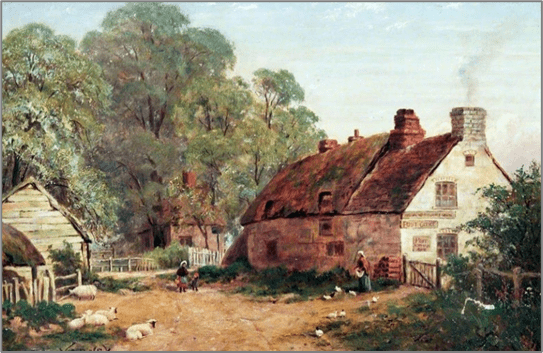
Benjamin Satchwell and his friend William Abbotts were instrumental in enabling Leamington to develop as a spa town after they discovered a source of mineral water on Abbotts’ land. At the time Abbotts owned and managed the Black Dog (see article), a pub on the High Street, whereas Satchwell occupied a thatched cottage on the corner of what is now Satchwell Place and New Street. Both men were property owners, tradesmen and residents of the small, obscure village of Leamington Priors on the south bank of the River Leam.
Satchwell was described as a cobbler by trade but he was in fact a man of many parts. He married Mary Whitmore in 1764 and had ten children by her. Quite a squeeze in the small cottage! Satchwell came originally from Stratford upon Avon and when he settled in Leamington Priors he set up to handle the first Leamington post from his cottage and took on the role of postmaster. In 1783 he became keeper of the village mail bag and residents would visit his cottage to receive and pay for their mail.
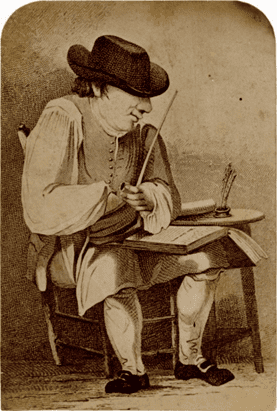
From Leamington Spa Art Gallery and Museum
The Black Dog in High Street (see article) was the village alehouse in which Ben Satchwell used to hold high court as the ‘oracular authority’ on all local questions.
His cottage, long since disappeared, stood on the exact spot where now stands a privately-owned building with the words ‘Satchwell Granary’ above the front door. It was previously Burman and Brewster’s corn stores.
In the 1790s the village had only about twenty houses within its bounds and all were thatched with straw. Satchwell relied on the few inhabitants for his livelihood. He repaired boots and also received a small fee for attending to the primitive postal arrangements. According to Margaret Watkins, writing on the Leamington History Group website, the post office consisted of a small black box about which you rapped with a tiny knocker to have your letter taken in. Letters were paid for when collected unlike today when the opposite is the case.
At the time of his death in 1810, Satchwell was still “postmaster” and his cottage still the post office. He was buried in the churchyard of All Saints and his tombstone still remains. There is a later inscription on the tomb which reads –
BENJAMIN SATCHWELL
Who among many charitable acts
Founded in the year 1806
The Leamington Spa Charity
Which excellent institution developed into the present Warneford Hospital
AD 1902
Despite him being instrumental in enabling Leamington to develop as a booming Spa town there is no evidence that he died a wealthy man. J C Manning, in Glimpses of our Local Past says that “Satchwell died poor, while doing gratuitous work for a purely benevolent association”. That is probably the way Ben Satchwell would most like to be remembered.
A blue plaque to commemorate Satchwell is now positioned to the left of the front door of the building which stands on the site of the old cottage.
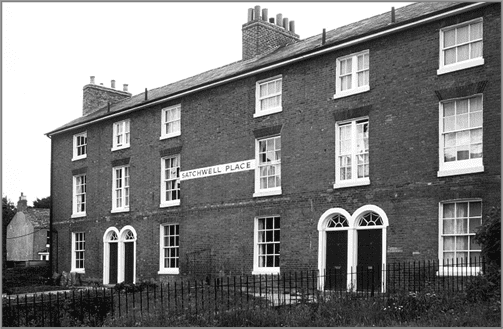
Satchwell’s daughter, Elizabeth, carried on the postal business, marrying a Mr R Hopton in 1816. Mr Hopton then took over the business which continued at the cottage until 1822. Mr Hopton was a man of ideas and had an eye for beauty. He set to work to improve the neighbourhood and at the same time enlarged his own home and laid out grounds attractively. He constructed a terrace of four boarding houses in the garden at the rear of Satchwell’s old cottage. These are known as Hopton’s Boarding Houses. The houses are hidden away down what is now Satchwell Place and owned by Orbit Housing. They have been Listed Grade II.
The houses are of reddish-brown brick in Flemish bond with dressings of red rubbed brick and Welsh slate roof. They have three storeys, six first-floor windows, the 2nd and 4th windows are shared between each house. All the windows are in plain reveals with sills and flat arches. The ground floor has paired entrances, six-panel doors with fanlights and decorative glazing bars in round-arched surrounds. Also 6/6 sashes in plain reveals with sills and cambered arches. The words ‘SATCHWELL PLACE’ are painted on the front centre of the terrace.
MIchael Pearson, 2018
This page is one of many which are based on articles in our book entitled A History of Royal Leamington Spa in 100 Buildings which was published in 2018 and is no longer in print.
ACKNOWLEDGEMENTS as presented in the book