
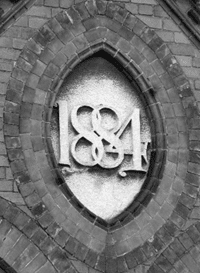
In 1884 the Leamington School Board’s first triennial report stated that they had great difficulty in securing suitable sites for two much-needed new schools to be built. In the south, after trying for land in the Ranelagh District, the only land available was in Shrubland Street, which was bought for £1,422.6s.0d It was said that the new school would accommodate 504 infants and 300 girls.
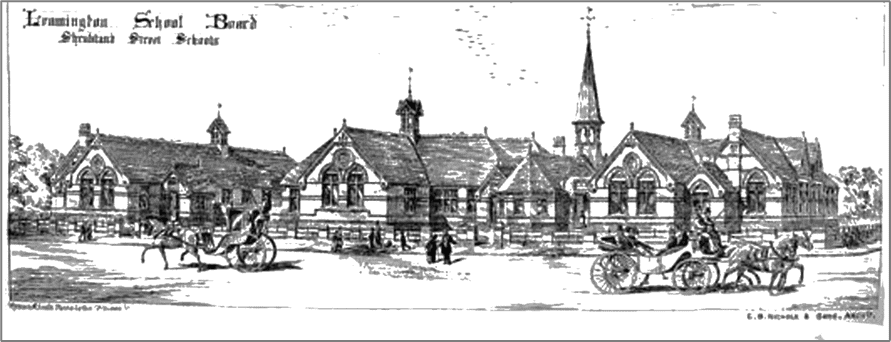
The architect was Mr. John Robert Nichols, of Messrs. G B Nichols & Sons of Birmingham. Mr. Thomas Bailey of Leamington was the contractor, and Mr. William Jenkins also of Leamington was the contractor for the heating. Mr. W Lait was clerk of works. The Leamington News reported that Shrubland Street schools, for girls and infants, opened on 8th July 1884. The Leamington School Board closed Spencer Street, Clarendon Street and William Street Schools and the girls transferred to Shrubland Street. Boys’ schools were to be built on adjoining land “when the need arises.”
The modern Gothic buildings were single storey, built of red brick relieved by bands and mouldings of Staffordshire brindled bricks, terra cotta and stone work. The roofs were of slate and featured ornamental turrets. Reports stressed the attention given to playground provision, and to the sanitary arrangements and ventilation. Altogether they provided accommodation for 1,608 scholars. Each school had a separate entrance and cloak-room with lavatory and other conveniences. Internally, the halls, corridors and school rooms had a dado of glazed brickwork, and the floors Staffordshire quarry-tiled. A room near the entrance provided the head teacher’s office. The girls’ school consisted of one large room, about 67ft x 24ft, with three large classrooms grouped around it. The classroom doors were half-glazed, so as to enable the head teacher to monitor lessons. Classrooms were divided by sliding half-glazed screens, so that assistant teachers’ and pupil teachers’ work could also be easily be monitored.
The report commented on every aspect of provision, from the wooden two-pupil desks, and the tiered seating, to the teachers’ desks and cupboards and the wood-block floors to keep noise down. The heating system, provided by local ironmaster, William Jenkins, was also highlighted.
Teaching followed contemporary requirements: “Tables were chanted every morning from the blackboard; passages from the bible and mournful poems were memorised and ‘said out loud’ in unison”. Discipline depended on the cane and “caning was administered indiscriminately to boys and girls alike”. There was a separate entrance to each school. The side walls of the entrance halls, and the corridors to the school rooms, had a dado of glazed brickwork, and the floors were of Staffordshire quarries.
Learning to write in the 1880s was no mean feat, especially when parents had to provide the resources. We learn from the log books that “a large number of poor children have no slates – sent home notes to parents requesting them to provide slates and pencils – in many cases they are too poor to do so”. Like other schools in the town, Shrubland Street had problems with attendance, either because of epidemics of childhood illnesses or more interesting events elsewhere: in 1885 the log book reads, “on account of the entrance of the circus, attendance very poor” and “attendance poor – especially on Wednesday on the occasion of a large funeral.” Staffing could also be a problem. In 1885, “a member of my staff has sent in her resignation today, because the salary given to assistants under the Board is quite inadequate”.
In March 1890, the erection of a Boys’ School in Shrubland Street became necessary. The Board had acquired land for the purpose and plans for a school to harmonise with the existing School. The new Boy’s School opened on Tuesday, 1st September 1891, under Mr. Warner Simpson, who had the distinction of being the first and, until modern times, the only elementary teacher to gain a B.A. London. In 1893 an inspector recorded, “This department seems to be highly and successfully organised. The boys are in very good order and do their work well.”
Events of national interest and pride held great importance within the school curriculum: Jubilee Day in 1897, the opening of the Victoria and Helena Wards at the Warneford Hospital, the relief of Mafeking, Empire Day, and similar events often meant a half-holiday, or a special tea in celebration. In July 1938, the school was closed to commemorate Leamington being a Royal Spa for 100 years. Throughout the period 1914-1918, there were frequent recordings by the Headmaster of the deaths in action of many of the ex-pupils – but he also recorded the actions of bravery by ex-pupils and medals they were awarded.
In September 1928, the school was again reorganised as a Junior Mixed and Infants School.
On 21st July 1939 children brought gas masks to school to do gas mask drill. At the end of August 1939, the school was closed until further notice for the reception of evacuated children. On 12th July 1944 the school had to close the following day, to accommodate children evacuated from London as a result of the attacks by flying bombs. It closed again in May 1945, in celebration of Victory in Europe Day.
Fast forward almost twenty years, to September 1963, when the school became Shrubland Street Junior and Infant School. Alterations were needed, but these were not completed until 22nd February 1966, with the new kitchen and new inside toilets ready for use.
1976 brought further reorganisation and changes: Shrubland Street Junior & Infant School became a First School with Cashmore School becoming the Middle School, where children stayed in the primary system until they were 12+. This made a difference to the staffing of all Middle Schools, who then had to teach the first year of the Secondary Curriculum. Specialist teachers for maths, science, music and modern languages had to be found, with the result that many worked part-time in more than one school. Somehow, it worked! In June 2015 the school, then known as Shrubland Street Community Primary School, celebrated winning in three different categories of the prestigious Times Educational Supplement awards. It won the Science, Technology and Engineering Team of the Year, Healthy School of the Year and the Arts and Humanities awards.
This page is one of many which are based on articles in our book entitled A History of Royal Leamington Spa in 100 Buildings which was published in 2018 and is no longer in print.