From the Portobello Bridge between Warwick and Leamington can be seen an intriguing group of old brick riverside buildings. The Rock Mill, a watermill built in 1792, is the most prominent; this stands next to a substantial Georgian house. Both of these have been redeveloped in recent years, with a row of modern town houses being built behind. Why ‘Rock Mill’? Old descriptions mention a large outcrop of sandstone near the mill reaching right to the water’s edge. This was quarried over many years, some of it carried on barges to Warwick for repairing the castle and use in other buildings.
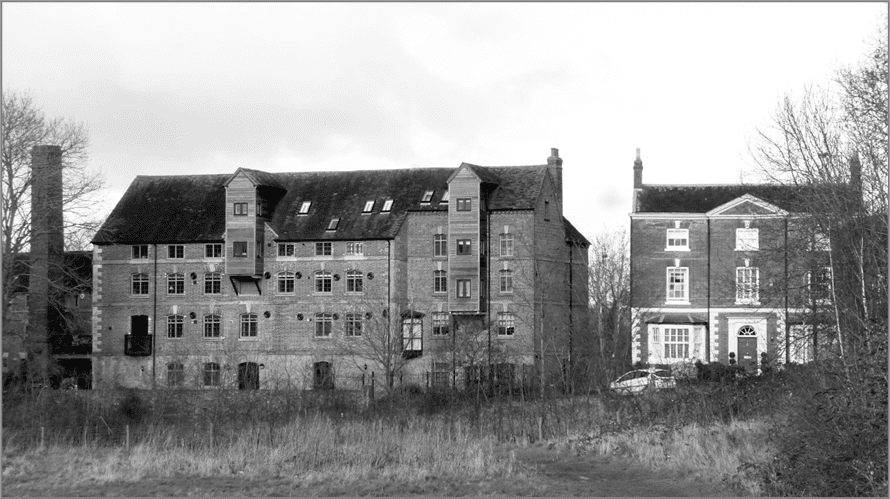
This important crossing-point of the Avon has provided a base for milling for perhaps a thousand years, and Milverton’s large mill in the Domesday Book was very probably here. By the seventeenth century this had become a fulling mill, processing woollen cloth. The traditional finishing process involved steeping the fabric in urine (ugh!), then pounding it with hammers powered by a waterwheel.
Some of the eighteenth-century fullers were Quakers, who by the 1770s included the Smart family. Benjamin Smart senior (1733-1816) was a respected figure and an elder at the Warwick Meeting House. The younger Benjamin Smart (1766-1839), a more ambiguous character, seized new business opportunities. He is the family member chiefly linked with the rebuilding of the mill in 1792 as a new manufactory for spinning cotton, using water power and later a steam engine. Like other cotton mills, this relied on child labour to operate the machines. Girls were used for this work as their nimbleness and small fingers enabled them to piece together the frequent breaks in the thread. Smart recruited his young workers from parishes in Oxfordshire and southern Warwickshire. He approached the overseers of the poor who sent him as pauper ‘apprentices’ young, often orphan-girls aged twelve and upwards. They were then required by law to continue with their master until aged twenty-one. Glimpses of apprentice life can be gained from a parliamentary enquiry into child labour in 1816. Theodore Price, a Birmingham manufacturer and JP, visited the mill during a stay in Leamington. One of the cottages near the mill (now called the White House) was very probably the ‘apprentice house’ where the child workers lived, supervised by a housekeeper who also gave them lessons on Sundays. Their meals and living quarters were acceptable, according to Price’s daughters. Price himself saw the girls working in the mill, describing their 12-hour days in a hot and dusty atmosphere, with few chances for play and relaxation. Although familiar with child labour in and near Birmingham, he was clearly shocked by conditions here.
Ironically, by the time of the select committee’s hearings in 1816, manufacturing here was winding down (and also in other textile mills around Warwick). Today there are places to learn about the millworkers’ life. One of the best is at Styal near Manchester, where the National Trust’s Quarry Bank Mill complex also includes an apprentice house. Benjamin Smart himself moved on to other ventures, in 1816 opening his ‘Imperial Marble Baths’ in Clemens Street. He later profited from boom conditions in Leamington through property dealing (while acting as town surveyor). From 1821 he lived in the former apprentice house with his second wife, Rebecca, and slowly enlarged it for their five children.
During the cotton-spinning era Rock Mill ground corn at nights and from about 1820 this was the main activity here. During 1837-42 it briefly became a factory again as the talented chemist, Charles Nelson, improved his new method of manufacturing gelatine. Needing more space, he moved to Wharf Lane in Emscote, where his growing works eventually employed many Warwick people.
From 1835 the Kench family from Dunchurch were local millers, firstly at the Navigation Mills on the Emscote Road (that building becoming the Fleur de Lys pie factory and now the site of council flats). In 1889 Sheldon Kench leased the Rock Mill, using it as a gristmill to produce animal feed. After his son Leonard was killed on the Western Front in 1916, he sold both mills to George Rishworth from Yorkshire. Rishworth and his two sons operated the mills as ‘Kench and Son’, but in the 1950s found it difficult to recruit workers in the face of the motor industry’s relatively high wages. After both mills closed in 1961, Rock Mill seemed to be sinking into dereliction. However rising property prices in the 1990s, together with some imaginative thinking, created the conditions for an upscale housing development. Whatever the drawbacks, this solution has saved the fabric of a fascinating old building.
Opposite to Rock Mill is Millhouse Terrace. No firm information has been found but there was probably a mill-house on this site and a mill on the river Leam to the rear of Edmondscote House.
This page is one of many which are based on articles in our book entitled A History of Royal Leamington Spa in 100 Buildings which was published in 2018 and is no longer in print.